Modules · Problem management

Treat the cause, not only the symptom.

Problem management goes back to the origin of recurring incidents, documents the cause and the workaround, and makes them available to the support teams.
Request a demonstration

Benefits

  • Fewer recurring incidentsRecurring incidents are grouped under a problem whose root cause is analysed, then corrected.
  • A workaround everyone knowsA known error publishes an article, and an incident’s record suggests the closest known errors.
  • Trends spotted in timeA symptom that repeats beyond a threshold raises an alert before the impact grows.
  • A managed resolutionThe fix goes through a change; closure is suggested once it succeeds, and the check stays human.

How it works

01

Identify

From an incident or a trend alert, a problem is created and the related incidents are attached to it.

02

Analyse

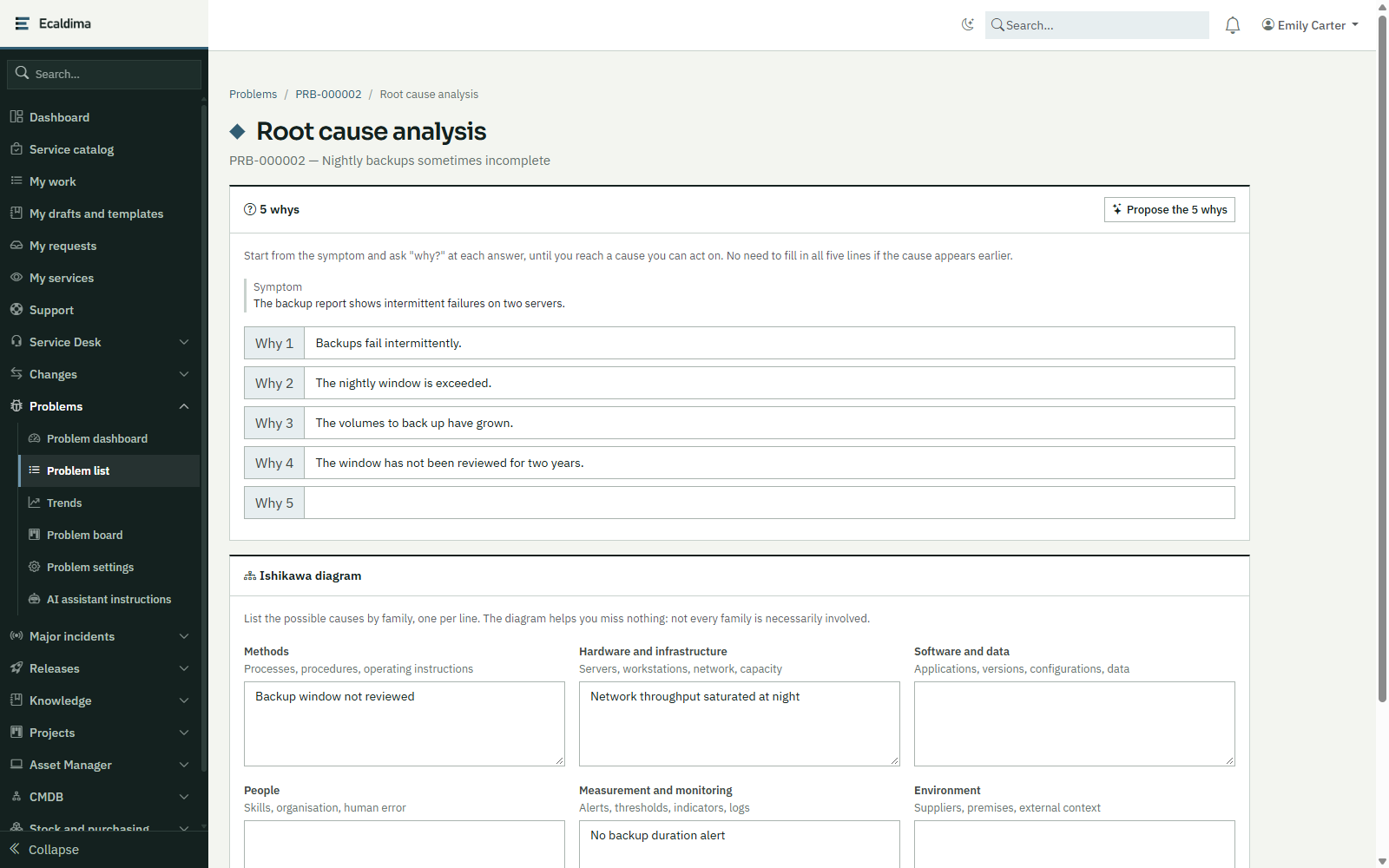
The 5 whys and the Ishikawa diagram structure the search for the root cause.

03

Work around

The cause and the workaround are written up; the known error is published in the knowledge base.

04

Fix

A change resolves the problem; the post-closure review keeps the lessons learned.

Related modules

Functional scope

  • Two modesReactive, from incidents (a single significant incident is enough); proactive, from a trend.
  • Life cycleIdentified, investigation, known error, change planned, resolved, closed; a root cause is required for a known error or a resolution.
  • Root cause analysisThe 5 whys and the Ishikawa diagram in six families, as an input structure.
  • Attached incidentsSearch for and attach several incidents at once; the link is visible from both sides.
  • Known error databaseAn article published with symptom, root cause and workaround, updated in one click, archived if the error is disproved.
  • Trend detectionAn adjustable threshold of incidents over a period, an alert to problem managers and a graphical trend view.
  • Management reportingOpen problems, recurrence, known errors without a workaround, resolution time, impact × frequency matrix and a Kanban board.
  • Post-closure reviewMandatory for a major problem: deviations noted and lessons learned.

Integrations

  • Service Desk, to attach incidents
  • Change management, for the fix
  • Knowledge base, to publish known errors
  • E-mail notifications, with editable templates
  • AI assistance to suggest the cause and draft the workaround, when the AI module is configured

Prerequisites

  • The problem managers, to be designated
  • A knowledge base for known errors, preferably internal

Want to see this module on your own processes?

We will build the demonstration around your operational reality.

Request a demonstration