Modules · Major incidents

Coordinate the crisis, regain control.

Major incident management organises the response to an incident whose impact calls for crisis coordination: one person in charge, a shared crisis room and stakeholders kept informed.
Request a demonstration

Benefits

  • One person in chargeThe crisis manager steers the phases and can hand over; every reassignment is traced.
  • A crisis shared in real timeThe crisis room brings diagnoses, decisions and events together in a feed everyone sees live.
  • Stakeholders kept informedInternal and customer messages, sent by hand or at each change of phase, with their history.
  • A crisis that feeds improvementClosure requires a blameless review and a link to a problem or an emergency change.

How it works

01

Declare

From an open incident: declaration criteria, crisis manager, video-conference link and affected items.

02

Coordinate

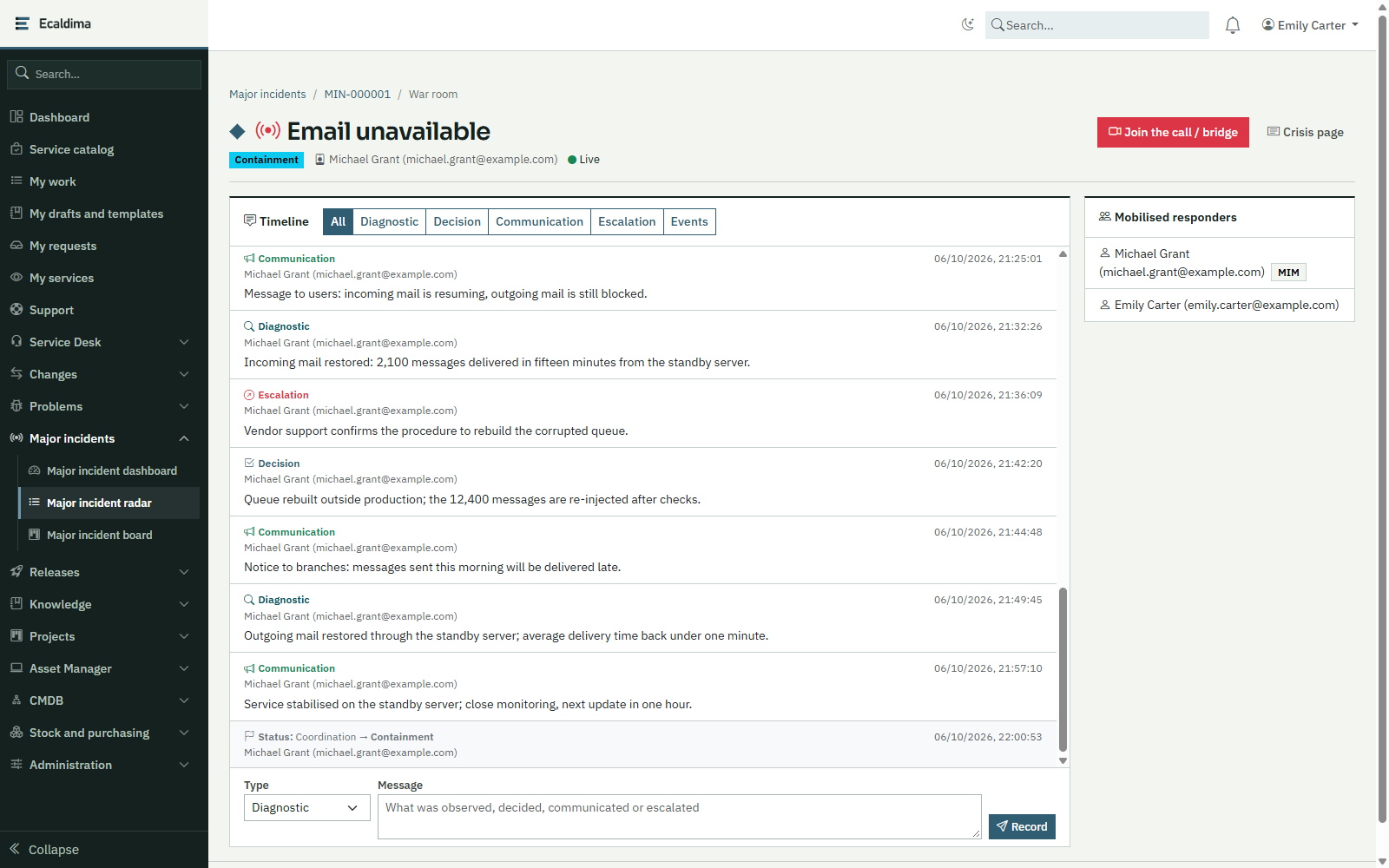
The crisis room records diagnoses, decisions, communications and escalations.

03

Stabilise and restore

The phases follow one another: declared, coordination, containment, resolved.

04

Learn

Post-incident review, emergency change and major problem to correct the cause.

Related modules

Functional scope

  • Declaration criteriaWide impact, critical service compromised, urgency with no workaround, financial, regulatory or reputational exposure, coordination between teams.
  • ITIL phasesDeclared, coordination, containment, resolved, closed, with a way back in case of insufficient containment or relapse.
  • Crisis managerA single lead at a time; handover and takeover are traced in the history.
  • Crisis roomReal-time feed, filters by type of entry, link to join the video conference or phone bridge.
  • CommunicationsInternal and customer audiences, standard messages, automatic notification at each change of phase.
  • Post-incident reviewRoot cause and improvement actions, pre-filled from the crisis feed; closure depends on it.
  • Management reportingCrisis radar, Kanban board by phase, average resolution time and rate of reviews completed.
  • Affected itemsIdentified in the CMDB, taken from the original ticket.

Integrations

  • Service Desk, the source of the declaration
  • Change and problem management, for the chaining
  • CMDB repository, for the affected items
  • E-mail notifications, with editable templates

Prerequisites

  • The crisis managers, to be designated
  • A video-conference tool or phone bridge, whose address is entered at declaration

Want to see this module on your own processes?

We will build the demonstration around your operational reality.

Request a demonstration